Tuesday, November 23, 2010

Chicken Katsu チキンカツ

Chicken Katsu is a variation of the popular Japanese Tonkatsu dish, which is a deep-fried pork cutlet. It's a form of Japanese comfort food that was invented in the late 19th century. It was originally considered a type of yōshoku—Japanese versions of European cuisine. I think it's a combination of the sauce and the japanese style bread crumbs, known as Panko flakes that makes this dish so tasty.

The bread crumbs are light and crunchy and makes a delightful crust when pan fried or deep fried.
In this dish I've substituted chicken breast cutlet for the pork cutlet or loin. The sauce that makes this dish is a thick, dark, fruity, intensely sweet and salty. It's made with the usual suspects, soy, vinegar, tomato, carrot and onion puree, corn starch, applesauce and of course, garlic. The cutlets are sliced to bite size and usually served over a bed of shredded cabbage with rice and sometimes with a pickled radish. This not exactly a low calorie dish, but like I said it is tasty and easy to make.


After a seasoning with salt and pepper, the chicken dredged in flour, then d
ipped in a egg and then into the panko flakes before hitting the pan. I simply use canola oil with a splash of sesame oil for a little flavor. Cook until a nice golden brown color is achieved remove from heat to drain on a paper towel over a pan. Let rest for a minute or two for the juice to reassert itself, slice across the grain and plate on a bed of sliced cabbage or lettuce. Serve with rice and vegetable side of you choice.


_______________________________________________


Chicken Corn Chowder


Hmmm hungry for a hearty bowl of chicken corn chowder? Fall is the perfect season to enjoy a bowl of hot creamy chicken corn chowder, and when I went to my local vegetable market, and saw the fresh corn on the cob, I knew exactly what was on the horizon.

I also happen to have some chicken that was needing a recipe to fill. So in a large heavy bottom pot, cook the bacon and keep the fat rendered, remove bacon for later. Add the onions, carrots, celery saute until tender then add the red and green peppers. season with chili powder, salt and pepper. Slowly add the chicken stock and deglaze, being careful to pick all the brown bit on the bottom of the pot. So much of the smokey flavor is picked during this process and makes the chowder so tasty.

Continue to add the stock and re-season with salt and pepper. Add the corn, thyme and Bay leaves and hot sauce. Let simmer for about hour.
Add the chicken, stir well and slowly add the half and half until rich and creamy. You can add a quick rue with two tablespoons of flour and two tablespoons of butter in a small sauce pan, cook thoroughly to remove floury taste and add to the the soup. Stirring constantly, bring the soup to a boil, then reduce heat and simmer for a few minutes, you can add some cheese if you like for even more creamy chowder at this point.

I got these wonderfully rustic sourdough bowl breads to pour the chowder into. Cut open the top and pullout the inside to create a bowl for the chowder. Sprinkle the chowder with the bacon bits and garnish with a little chopped parsley or scallions.

Ingredients:

  • 1 1/2 cups chicken cooked
  • 3- Ears corn on the cob
  • 3- Strips Bacon cut into one inch pieces
  • 2- Russet or Yukon Potatoes
  • 1- Red Pepper
  • 1- Green Pepper
  • 2- Stalks Celery
  • 2- Sticks of Carrots
  • 1- Vidalia Onion
  • 2- bay leaves
  • 1- teaspoon fresh thyme
  • 1- teaspoon Rock Salt
  • 1- teaspoon Coarse Black Pepper
  • 1- teaspoon chili powder
  • 1- Pint Half and Half
  • 3- Cups Chicken Stock/Broth
  • 1/2 teaspoon Hot Sauce
  • 2- Tablespoons Flour
  • 2- Tablespoons Butter
____________________________________________

Sweet Pepper Coulis Scallops


This is actually a very simple dish I had a craving for. The making of the sweet pepper coulis was a mission on it's own, but when it all came together it was a wonderfully delicious sweet tangy dish.

The Sweet Pepper Coulis is the hero of this dish and it takes a little time to make, so you might want to make this a day in advance. Seed a good size red bell pepper, be sure to remove ribs and cut into strips. Chop half an onion and three stalks of scallions. In a sauce pan add the oil and saute the onions, peppers until nicely wilted. Add garlic and season with salt and pepper, add chili powder. Add the cider and chicken stock along with the scallions, reduce heat and simmer until sauce is reduced by half about two hours. Strain the mixture through a fine sieve and discard the the solids. Simmer the sauce for another hour, in a small bowl or dish add the corn starch with equal parts water and mix. Add the corn starch to the sauce until sauce thickens.

The scallops are pretty straight forward, take the dry ingredients and and mix well. In a separate pan, add a touch of olive oil to the scallops and sprinkle with old bay and salt and pepper. Coat the scallops in flour mixture. Add oil and heat pan, when oil and pan reaches add scallops and sear on both sides careful not burn them. Place the scallops on plate and and spoon coulis over scallops, I made a wilted spinach salad topped with broccoli sprouts and bacon bits. Add a touch of balsamic reduction and enjoy...


Ingredients:


Sc
allops
  • 1lb Sea Scallops
  • 1/2 cup Flour
  • 1 tsp Old Bay
  • 1/2tsp Garlic Powder
  • 1/2tsp Pepper
  • 1/2tsp Kosher salt
  • Pinch Paprika
  • 1tsp Olive Oil
Sweet Pepper Cider Coulis
  • 1lrg Red Pepper
  • 1/2 Onion
  • 3 Stalks Scallion
  • 1/2 cup Apple Cider
  • 1/2 cup Chicken or veal stock
  • 1/4 cup white wine
  • 2 tblsp Sweet Chili sauce
  • 1 tblsp Hot Sauce
  • 1 tsp Chili Powder
  • 2 cloves Garlic chopped
  • 1 tsp Coarse Black Pepper
  • 1 tblsp Corn Starch
____________________________________________

Sunday, September 5, 2010

Asian Fusion, Lo mein, Bulgogi, Sweet and Spicy Shrimp

A lot of Asian food share similar qualities, and yet still remain distinctive to their native origin. The again, who's to say who originated what? So why not just mix them up a bit to create a fusion dinner. Which is just what I did here, and on many other occasions.
_____________________________________________________
Lo mein

Lo mein is a pretty traditional Chinese dish w
hich I eaten all my life. It's basically a noodle dish that contains vegetables and some kind meat, fish or poultry. The term lo mein comes from the Cantonese lōu mihn (撈麵), meaning stirred noodles. It has over time been Americanized, and people expect to have a soft noodle that's been stir fried in wok with a brown sauce with an assortment of vegetables like carrots, onions, scallions, snow peas, bean sprouts, bok choy and others. The dish is defined by it's main meat component such as roast pork (Char Siu), chicken, beef, shrimp, lobster and any combination thereof. The dish could be considered a meal in itself, but when I was growing up, it was considered a side dish.
_________________________________________
Bulgogi


Beef Bulgogi is a
very popular Korean meat dish. The thinly sliced sirloin is marinated with a mixture of soy sauce, sugar, sesame oil, garlic and other ingredients. Bulgogi is traditionally grilled, but pan-cooking is also common practice. This is sort of Korean style teriyaki, where the sweet salty marinade is used to infuse the meat with a distinctive flavor. Bulgogi literally means "fire meat" in Korean, which refers to the cooking technique—over an open flame—rather than the dish's spiciness. I pan cooked my Bulgogi and added firm tofu, onions and scallions for a bit of color. You can add other vegetables to the process like sweet red bell peppers, zucchini, squash, mushrooms etc. I kept my version fairly simple. You can make your own sauce and marinate overnight, or if you're lucky, you have a Korean market nearby that's got it all ready for you.
_____________________________________________________
Hot & Spicy Shrimp

Who's to say where this dish originated and how to prepare it is as equally diverse. There are Hunan versions, Sze
chuan versions, Thai versions and so on. This one is my own interpretation, using a chili sesame oil and canola oil. This really simple dish to prepare and the results are well rewarding. The trick is to be careful how hot you make it. A common method for making Chinese style (Szechuan) spciy shrimp uses a technique called "velveting" where the shrimp is submerged into hot oil for a moment or two before going into the wok to be stir fried. I added sweet red and green bell peppers and onions.

_________________________________________

Thursday, August 26, 2010

Kiwi Coolada


Warning, do not try this at home unless you are very hot and thirsty and dying for something cool, fruity and refreshing.

This could very well be the best Hot Summer Day fruit drink I have ever ingested. It makes perfect sens
e, with all the trimmings of a Pina Colada with the addition of the tangy Kiwi fruit makes for an extraordinary thirst quencher. Use fresh pineapple whenever possible, but any will do even from a can (Dole brand of course). Add a little cream of coconut, a few good shots of Midori and Bacardi Dark Rum, some ice into the blender...

You're gonna be licking the blender for more... so make plenty...

_______________________________________________

Poached Pears

I love pears, I like them fresh, crispy and cool. I also like them poached, soft, tender and sweet. I've been looking at a lot of different recipes and wanted to try something different. I was tempted to do a simple wine based poaching, but I was afraid to do a red wine version, and white wine just seemed ordinary. So I decided to use a recipe that called for green tea.

I didn't go crazy here, but to be sure, there are quite a few green tea options. I just used what I had and brewed a strong pot for my poaching
, because as a twist, I also added fresh squeezed orange juice along with a little zest and Seville Marmalade. Of course the other big deal is what kind of pear to use. I've seen recipes for virtually every kind of pear, but the most common seemed to be Bosc, with Anjous also being very popular. I happen to find some really nice looking Golden Taylor's which were very sweet and succulent. These pears are a little rounder in shape and don't have that narrowing at the top. They have a similar outter skin to bosc, no sheen and brownish yellow or gee golden colored. The bosc pear was a logical choice, and they are generally fairly sweet, they are firm and peel very nicely to enhance their lovely classic shape. I kept the stem on. So peel the pears to let the fruit absorb the liquid. I left a little bit of skin at the tip for aesthetic reasons. Unfortunately the Golden, did not have long stems but peeled nicely.

I cut the golden in half and core
d it, while I cut the bottom of the bosc at an angle so it would stand up and cored it from the bottom. I added 3/4 cup of sugar to the brewed tea and about two tablespoons of marmalade. I squeezed the juice of one large orange and included some zest before adding the pears. I simmered the pears for about 30 minute making sure they stayed submerged and rotating them in the liquid. The golden is a bit softer and more porous than the bosc and consequently poached faster, I kept it in for about 25 minutes and they were nice and tender.

________________________________________________

Sunday, August 22, 2010

Kiwi Lime Cream Pie

I have been searching for a easy but tasty cream cheese recipe that didn't involve baking. I think I found it, and it's as creamy and tasty as you can imagine, without a single egg. I used sugar to sweeten, but I suppose you could use a sugar substitute like Splenda. Otherwise, I kept the recipe to fat free cream cheese, non fat cool whip and lowfat yogurt. I cheated and added a little mascarpone cheese for creaminess.

Filling Ingredients
  • 2 - 8 0z Packages no fat cream cheese
  • 4 - oz of marscapone cheese
  • 3 - limes for juice and zest
  • 1 - 6 oz KeyLime Kiwi Low fat yogurt
  • 2 - tablespoons coolwhip
  • 1 - Packet Knox gelatin

Glaze
:
  • 3 - Tablespoons marmalade or apricot preserve
  • 1/3 - cup water 1/4 - sugar - optional

Crust:
I used a ready made gram cracker crust, but make your own. This recipe is meant to be a bake free to save a little time...


Bring cream cheese to room temperature and simply mi
x yogurt, marscapone, lime juice and zest until smooth. I did it by hand but your mixer will be better hehehe... fold in the cool whip. Prepare the gelatin as directed and add to mixture, incorporate completely, pour in to the pie shell and place in the refrigerator to cool. In the meantime you can prepare the glaze, in a sauce pan, add the water, sugar and marmalade until smooth and simmer to a boil, remove from heat. Peel and slice the kiwi and whatever other fruit topping you want to use. After pie has cooled, top with the Kiwi and other toppings, brush the glaze over the fruit to prevent it from browning. When ready to serve or present, add whipped cream. Or you could use a stabilizer in your whipped cream to keep it stiff longer.

There you go... a low fat, Kiwi Lime Cream Cheese Pie.


________________________________________________

Monday, August 16, 2010

Sushi


I've had sushi all my life, growing up in Hawaii, where it's a staple. As a kid, I remember being able to get maki rolls and cone sushi (Inari) for 25¢. They weren't fancy, in fact in some instances, the Inari was simply plain sushi rice in the abura age (fried tofu packets). Sushi, was and is pretty common in Hawaii so I never thought much of it , being able to get just about about anywhere.

It really wasn't until I moved to New York City with my high school sweetheart that I began to crave sushi, and become aware of the more exclusive nigiri type sushi. For me sushi and Japanese food was about as synonymous with Hawaiian food as I was gonna get in New York. But the 30 years ago, Japanese food in the City was not nearly as prevalent as it is now, and in most major metropolis cities in the U.S. at least.
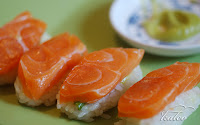
Nigiri sushi is composed of hand formed rice usually with a swab of Wasabi applied to the rice and a piece of "fresh" raw fish laid on top. The variety of nigiri sushi is as wide as the kind of fish available to make it with. Sushi making has been nearly been elevated to a high art form, with practical and talented hands and finger techniques for forming the rice pods or rolling the maki in nori. Apparently sushi chefs spend many years perfecting the finger and hand techniques to properly form sushi rice.

One of the popular kinds of sushi I enjoyed as a kid, is the cone sushi or inari sushi which is rice stuffed into a fried tofu pocket. The simplicity of this sushi, with it's sweet taste of the rice with the tofu wrapper is unique and satisfying flavor. In this sample I inserted a a finger full of spicy japanese seaweed (Goma Wakame), and topped it with fine chopped carrots and scallions. Toasted black and white Sesame seeds is also an attractive and tasty garnish.

The Maki rolls are almost equally diverse in kind. Maki rolls use No
ri, a kind of seaweed made by a shredding and rack-drying process and comes as thin as paper. You place the rice and the fillings on the nori and roll it up using a special bamboo mat made for the job. You could wrap just about anything fresh in the rolls, here I used cucumber, carrots scallions and salmon. I had some yellow pickled radish (Daikon) that I meant to use, but forgot, it's also a popular ingredient in maki rolls.

As the popularity of sushi has grown, so has the innovation in the ingredients and methods. A popular
new kind of sushi is the California roll which is rolled into a cone sushi using the nori wrap and usually containing a certain amount of avocado and crab meat. In Hawaii, local favorite is known as Musubi, a kinda nigiri using fried spam as the topping. We even have a Philadelphia roll, using... you guessed... Philadelphia cream cheese as a filling ingredient

For the rice
  • 2 cups short/medium grain white rice (I used Nishiki brand) Do not use long grain
  • 1/3 cup rice wine vinegar
  • 1/3 cup sugar
  • 2 tablespoons mirin
  • 1/2 teaspoon salt
For the fillings

8 ounces Fresh fish (sushi grade) of your choice
4 crab legs (Kani) or immitation crab meat
3 stalks scallions (green onions)

1 cucumber - julienne

1 large carrot - julienne

1 Avocado - sliced
1 Daikon pickled radish
1 Tablespoon wasabi - more or less to taste


________________________________________________

Sample kinds of fish used for sushi and sashimi

Tuna - Maguro
Salmon - Sake

Yellowtail - Hamachi

Shrimp (cooked) - Ebi

Red Snapper - Ma-Dai
Sea Bass - Suzuki

Mackeral - Saba

Butterfish - Ibo-Dai
Octpuss - Tako

Eel - Unagi
Squid - Ika

________________________________________________